Showing posts with label solo. Show all posts

Tuesday, September 29, 2009

Flying at Night

One of the FAA requirements for a pilot's license is three hours of experience flying at night. When I'm a passenger on a commercial flight, I love flying at night. The air is smoother, the city lights always sparkle, and everyone's sleepy, which makes for a very calm and peaceful flight.

Piloting an airplane at night is not so peaceful. For me, it was very stressful. Night flying is challenging, for the obvious reason that it's really hard to see anything! Pilotage (navigating by landmarks) is all but impossible. Mountains become practically invisible. And there's no good horizon to reference.

I had no idea how hard it would be to spot airports at night from the air. I thought that since they take up so much land and are so well-lit, they would just jump out at me. On the contrary; to spot an airport from the air, you look for a dark spot! The runway lights are designed to only be visible when you're close-in. In fact, the best strategy for finding an airport at night is to look for the beacon, which is a rotating green-and-white spotlight that is usually mounted on a tall tower or on top of a building, like a nineteenth-century lighthouse guiding ships into port.

Night flying isn't all bad, though. It's really easy to spot other planes because of their bright, flashing lights. Also the air is very smooth and there is hardly any wind.

--

Flying to Palm Springs
The FAA also requires student pilots to get five hours of experience in solo long-distance flights. My flight to San Luis Obispo (which I talked about here) satisfied 3.5 hours. To get the other 90 minutes, I decided to fly to Palm Springs.

And what a flight! Whereas my flight up the coast to SBP was quiet and uneventful (just look at all those pictures I had time to take), this flight was busy. It started, like my last flight, by almost being cancelled (that is kind of a theme in general aviation). Low, overcast clouds had descended over Santa Monica and were not forecast to be gone for hours. Fortunately my flight instructor, who is instrument-rated and able to fly through clouds (in a single bound!), offered to fly with me to Van Nuys airport (in the sunny San Fernando valley), where he could catch a cab back to Santa Monica and I could continue on to PSP in the plane. So we did that, and I got a little taste of flying an IFR clearance. Fun!

So the weather was mitigated, but I had another complication to contend with: Joe Biden. The vice president was in town, and with him came "temporary flight restrictions," or TFRs. So I had to plan my flight around those areas where he was planning to be.

Fortunately my flight plan worked out perfectly, and I stayed out of the no-fly zones and made it to Palm Springs in just about one hour. Unlike my last flight, this one took me through some very crowded airspace, and I spent a lot of time talking to air traffic control and didn't get to take many pictures in flight. I did get a picture of my old high school, though. I thought that was cool.

--

Believe it or not, I'm almost done. I've got all the required experience, including the forty hours of total flight time for which this blog is named. From here on out, I'm just practicing for the checkride (and studying for the written exam). I did a "mock checkride" last weekend, in which my instructor played the role of FAA examiner and put me through all the maneuvers as if I were being tested. I won't lie; it went miserably, but at least I now know what I need to practice. Stay tuned!

Monday, August 17, 2009

My First Solo

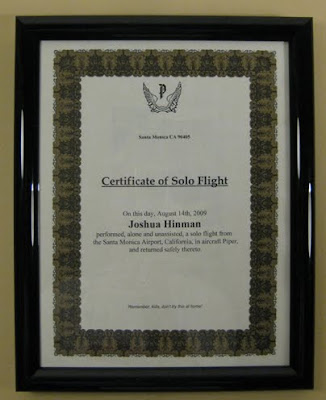
I have a new decoration for my office wall:

Certificate of Solo Flight

As I promised in my last entry, I flew the airplane solo! Last Friday we had a temporary break in the cloudy weather, so I rushed down to the airport on my lunch break (about a 15 minute drive). First I went up with my instructor, executed two unassisted landings and taxiied back to the ramp. Then my instructor got out of the plane, wished me good luck, and I was on my own. I taxiied the airplane back to the runway and let the tower know that I was a student pilot doing my first solo. As soon as I was cleared, I took off!

I was far too focused to be very excited at this point. All that was in my head were the things I needed to do: keep the wings level, fly runway heading and climb at 80MPH. At the end of the runway, turn left and overfly the golf course for noise abatement.

I'm so used to having an instructor in the right seat that as soon as I leveled off at the pattern altitude and had a moment to take a breath, the quiet in the cockpit got to me and I actually felt a bit lonely.

That passed very quickly and was replaced by, holy cow, this is not Microsoft Flight Simulator. I am flying an actual freaking airplane in the actual sky (really!), which was quite clear and beautiful that day.

As soon as I reached a point towards the end of my downwind leg, tower cleared me to land and I began my descent. Now I was back to being extremely focused: flaps, speed at 85, descend at 500 fpm, glide, break the glide, flare, touchdown.

Back to the ramp. I marked my logbook: 0.7 hours dual instruction, 0.3 hours solo. I returned to work that afternoon with a huge grin on my face.

Thursday, August 13, 2009

Weather

As I write this, I am staring at two new endorsements in my log book: certification of pre-solo flight training and pre-solo aeronautical knowledge.

This means that at 13.2 hours and 50 take-offs and landings, I am now signed off to take the plane up by myself! I haven't done this yet, though, due to weather.

The past week or so, Santa Monica has been experiencing a very annoying, persistent marine layer. We're used to low clouds and fog in the mornings, but lately these conditions have been lasting all day, which means no flying for me.

Obviously clouds are no factor for commercial airliners, so you might wonder why they are such a big deal for me. The answer is that all of my training flights are done under "visual flight rules." Visual flight rules (VFR) means that it is my job to "see and avoid" other aircraft. Air traffic control will help when they can, but ultimately it is up to me. If I am flying through a cloud, I am blind, and that is bad.

Later on, after I get my pilot's license and have at least 50 hours of experience, I can get an "instrument rating" that allows me to fly in the clouds under certain conditions. Yes, I do plan to get this. But until then, I'll be staying at least 500' below, 1,000' above, and 2,000' horizontally away from any clouds.

Thursday, August 6, 2009

Landing: Check.

I had a GREAT lesson this morning! We did nine landings, eight of which were completely unassisted, and they were all pretty fantastic. In the one that was assisted, I came in too high and attempted a "slip" to lose altitude*. I screwed up the slip maneuver, ended up off track, and my instructor had to help me out with some right rudder.

We also tried one landing with no flaps, just to see what it felt like. The result of that was we landed at 90 miles-per-hour instead of 80 and rolled down the runway about twice the distance we usually do.

I now have "landing" checked off on my pre-solo checklist. I believe the only things I have left to do are slow flight and emergency procedures, and then I'm going solo. Wish me luck!


* A slip is when I bank the airplane to one side, as if I was going to turn, but I use full, opposite rudder input to keep the plane on the same track. The result is that the nose stays pointed toward the runway, but one wing will be lower than the other, and the resulting drag from the full rudder deflection slows the airplane down considerably.

Thursday, July 30, 2009

All By Myself

Yesterday marks the second lesson I've had to cancel due to poor weather (low overcast clouds).

It wasn't a total bust, though. I spent an hour on the ground with my instructor going over the pre-solo written test. I am very close to flying my first solo flight! As might be expected, I am equal parts excited and nervous about this. I feel ready. I've memorized my checklists. My last few flights have gone very well, but I still need more landing practice.

The competitive part of me wants to know the average time to solo and how I compare to it. My goal is to solo at or before ten hours (i'm at 7.6 now). Another student at my flight school recently went solo at seven hours, and I was secretly hoping to beat that, but that's okay.

After my solo, the next thing I'll be working on is my first cross-country flight, followed by a solo cross-country (in aviation terms, "cross-country" is a flight that is further than 50 nautical miles, not literally across the country). I am very excited for this, because it means flight planning and geeking out with maps! It also means flying into new airports. Not that Santa Monica and Van Nuys aren't great places to fly; I just think I would enjoy a change in scenery.